
Medical Assisting

Request Information
All fields using an asterik (*) are required.
Program Details
What Will I learn
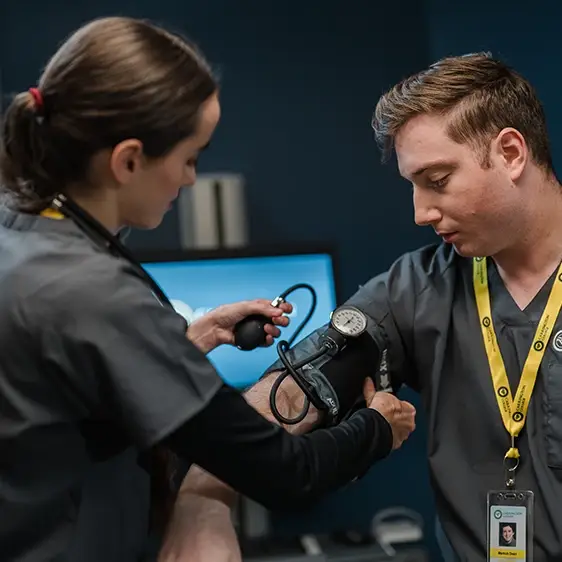
Carrington College’s Medical Assisting certificate provides hands-on training in both patient care and medical office procedures, preparing you for a vital role in healthcare.
Upon completion of the medical assistant training program, graduates will be able to:
- Apply anatomical and physiological concepts to normal body function and common disease processes using accurate medical terminology
- Administer medications safely using correct dosage calculations, routes, and documentation standards.
- Perform laboratory and clinical procedures according to safety protocols, quality standards, and regulatory requirements.
- Coordinate patient care by providing education, resources, and support that promote health and continuity of care.
- Manage administrative operations by maintaining accurate records, supporting scheduling and billing, and using EHR or EMR systems to keep workflows efficient.
- Communicate effectively using professional verbal, nonverbal, and written skills.
- Comply with laws, ethical standards, and professional guidelines to protect patient rights and maintain confidentiality.
Carrington College prepares students to take appropriate certification and licensure exams related to their individual majors. The College does not guarantee students will successfully pass these exams or be certified or licensed as a result of completing the Medical Assistant program.
Military Policy
Cost & Financial Aid
Your education is an investment in your future, and Carrington College is here to help. We offer a variety of financial aid options, including federal, state, and private programs, as well as student loans, grants, and scholarships are available for those who qualify. Each program has different requirements and application instructions. Our team is here to guide you through the options and application process.
Academic Cost
For complete details on current tuition costs, please refer to the Academic Catalog.
Location Availability
Carrington College’s medical assistant training program is available online and at a number of locations. We also offer an associate degree option online. To learn more about each location, explore their location pages.
Online students: All Medical Assisting classes in this program are offered in an online format, except the in-person externship that is completed at an approved healthcare setting.
Accreditation & Approvals
Carrington College is accredited by the Accrediting Commission for Community and Junior Colleges, 428 J Street, Suite 400, Sacramento, CA 95814; 415 506 0234 an institutional accrediting body recognized by the Council for Higher Education Accreditation and the U.S. Department of Education. Additional information about accreditation, including the filing of complaints against member institutions, can be found at accjc.org.
For comprehensive information on Carrington College’s accreditation and approvals, visit stg.carrington.edu/accreditation-and-approvals/.
Course Catalog
Program Specific Disclosures
Continuing Education For Graduates
Student Outcomes

REAL WORLD SKILLS

START YOUR PATH

FLEXIBLE LEARNING OPTIONS

AFFORDABLE TUITION
Overall, my experience at Carrington College was incredibly positive; the entire staff was helpful and hands-on.
Medical Assistant Career Opportunities
According to the Bureau of Labor Statistics, medical assistants complete administrative and clinical tasks in the offices of physicians, hospitals, and other healthcare facilities. Their medical assistant duties vary with the location, specialty, and size of the practice. These duties can range from the front line of patient care to behind the scenes of organizational healthcare. They can include the following:
- Interview patients and record their medical history
- Measure patients’ vital signs, such as their blood pressure and weight
- Help physicians with patient examinations
- Give patients injections or medications as directed by physicians and as permitted by state law
- Schedule patient appointments
- Collect and prepare samples of blood and other specimens for laboratory tests
- Enter patient information, such as their vital signs and test results, into medical records
- Maintain inventory of medical and office supplies
What Will I Learn?

Medical Office Functions

Diagnostic Tests

Explain Patient Procedures

Equipment and Supplies
Check Out Our Guide on How to Become a Medical Assistant
Have you always wanted to work in a medical setting, but don’t want to attend school for years? Then a job in medical assisting might be a good career for you. Medical assistants work in a variety of roles in medical offices and clinical settings supporting the licensed staff with technical tasks.
Discover What It's Like in the Medical Assisting Program at Carrington College
Medical Assisting FAQ
How long does it take to become a medical assistant?
One of the benefits of learning how to become a medical assistant is that you can prepare to enter the working world much faster than other medical roles. You can complete a Medical Assisting training program in as few as 9 months for a certificate of achievement.
What is the average Medical Assistant program cost?
The average cost of medical assistant training will vary widely based on the institution at which you are enrolled, any financial aid you receive, and whether you seek a certificate or associate degree. To learn more about the cost of Carrington College’s Medical Assistant program, check out the Academic Catalog.
Do you need a degree to be a medical assistant?
You do not need a degree to work in medical assisting. According to the Bureau of Labor Statistics, although there are no formal educational requirements for medical assistants in in most states, employers may prefer to hire assistants who have completed a Medical Assistant training program. Carrington College offers a Medical Assisting Certificate that can be completed in as few as 9 months.
Is a medical assistant higher than a CNA?
A certified nursing assistant (CNA) is an entry-level healthcare worker who helps nurses with patient care. A medical assistant, on the other hand, works with more members of a medical team and may also fulfill some clerical duties. It is hard to say if a medical assistant is higher than a CNA, as they are separate roles.
What Medical Assisting classes will I take?
A sample of Medical Assisting classes at Carrington College may include:
MA Administration Theory 1—This course provides theory in the following areas: telephone techniques, oral communication, verbal follow-up, written follow-up, managing and maintaining the office, computers, appointments, records and filing, patient education, legal issues and biomedical ethics.
MA Clinical Applications 1—This course provides concepts and entry-level skill applications for the following procedures: vitals including height, weight and vision screening, aseptic hand washing, lab safety, microscopes, venipuncture, injections (parenteral medications), ABO/RH typing, capillary puncture, hemoglobin, hematocrit, glucose, urinalysis, audiometer and electrocardiography.
or
Clinical Application—In this course students will discuss the role of the medical assistant in a clinical setting. Students will demonstrate noninvasive procedures such as electrocardiograms and vital signs. They will prepare exam rooms, exam trays, using medical and surgical aseptic techniques. They will discuss blood-borne pathogen guidelines for a safe medical office.
Medical Office Management—This course is designed to equip students with the essential skills and knowledge required in medical office management and communication. Students will learn the fundamentals of providing exceptional patient care, mastering effective communication, understanding office management responsibilities, exhibiting professional conduct, and utilizing medical office software applications.