
Respiratory Therapy Program Training

Program Details
What Will I learn
Respiratory Therapy
Upon completion of the Respiratory Therapy program, graduates will be able to:
- Perform clinically as a competent advanced-level Respiratory Therapist.
- Exemplify critical thinking and judgment skills.
- Demonstrate personal and professional behavior consistent with a Respiratory Therapist.
- Earn Basic Life Support (BLS), Advanced Cardiac Life Support (ACLS), Pediatric Advanced Life Support Provider (PALS), and Neonatal Resuscitation Provider (NRP) certifications.
- Become a Registered Respiratory Therapist.
- Characterize the philosophies of lifelong learning and professional growth by participating in continued education and community outreach.
- Demonstrate the social skills, professional appearance, attitudes, and behavior that employers expect of graduates.
- Relate and apply concepts of communication, reasoning, critical analysis, ethical behavior, and appropriate interpersonal interaction to situations in his or her career and personal life.
Military Policy
Cost & Financial Aid
Your education is an investment in your future, and Carrington College is here to help. We offer a variety of financial aid options, including federal, state, and private programs, as well as student loans, grants, and scholarships are available for those who qualify. Each program has different requirements and application instructions. Our team is here to guide you through the options and application process.
Academic Cost
For complete details on current tuition costs, please refer to the Academic Catalog.
Location Availability
Carrington College’s Respiratory Therapy program is available at multiple campuses in three states. To learn more about each location, explore their campus pages.
Accreditation & Approvals
Program Goals
The Carrington College Respiratory Therapy program goal is to prepare graduates with demonstrated competence in the cognitive (knowledge), psychomotor (skills), and affective (behavior) learning domains of respiratory care practice as performed by registered respiratory therapists (RRTs).
Program Accreditation
The Respiratory Therapy Associate of Science degree program at Bakersfield (#200425), Las Vegas (#200536), Ontario (#200495), Phoenix (#200390), Pleasant Hill (#200542) Rancho Cordova (#200518), Temecula (#200607), and Visalia (#200389) campuses are accredited by the Commission on Accreditation for Respiratory Care (coarc.com).
Outcomes Data
The CoARC accredits Respiratory Therapy education programs in the United States. To achieve this end, it utilizes an ‘outcomes-based’ process. Programmatic outcomes are performance indicators that reflect the extent to which the educational goals of the program are achieved and by which program effectiveness is documented.
To view outcomes data, please visit coarc.com/students/programmatic-outcomes-data.
Carrington College is accredited by the Accrediting Commission for Community and Junior Colleges, 428 J Street, Suite 400, Sacramento, CA 95814; 415 506 0234 an institutional accrediting body recognized by the Council for Higher Education Accreditation and the U.S. Department of Education. Additional information about accreditation, including the filing of complaints against member institutions, can be found at accjc.org.
For comprehensive information on Carrington College’s accreditation and approvals, visit stg.carrington.edu/accreditation-and-approvals/.
Course Catalog
Program Specific Disclosures
Continuing Education For Graduates
Student Outcomes

REAL-WORLD SKILLS

START YOUR PATH

FLEXIBLE LEARNING OPTIONS

AFFORDABLE TUITION
The support system in this program was phenomenal…studying something so completely new to me was a shock, but the instructors made it understandable and achievable. I fell in love with it.
Career Opportunities
Respiratory therapists care for those who have trouble breathing. Some of the most common chronic respiratory illnesses are chronic obstructive pulmonary disease (COPD), asthma, occupational lung diseases, and pulmonary hypertension. According to the World Health Organization’s most recent data, more than 262 million people had asthma globally1 and there were 3.23 million deaths from Chronic obstructive pulmonary disease (COPD) globally in 2019.2
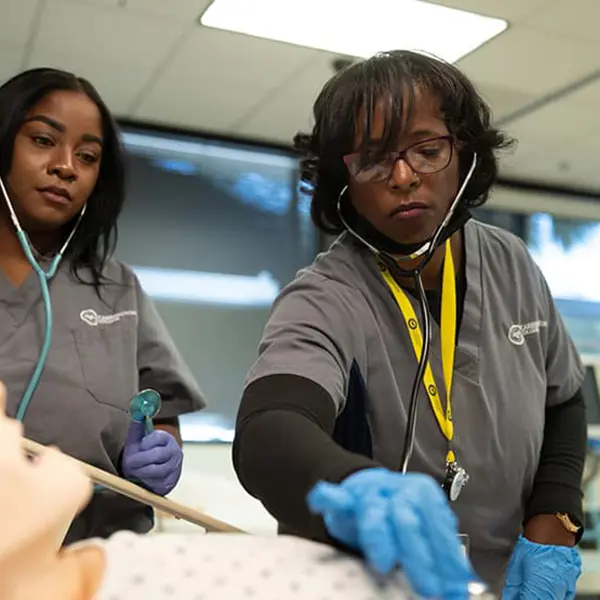
Respiratory therapists work with common respiratory patients like those described above, as well as everyone from premature infants with undeveloped lungs to elderly patients who have diseased lungs. Respiratory therapists also provide emergency care to patients suffering from heart attacks, drowning, or shock, according to the BLS.3
Some common job duties of a respiratory therapist include:
- Interviewing and examining patients with breathing or cardiopulmonary disorders
- Consulting with physicians to develop patient treatment plans
- Performing diagnostic tests, such as measuring lung capacity
- Treating patients by using a variety of methods, including chest physiotherapy and aerosol medications
- Monitoring and recording patients’ progress
- Teaching patients how to take medications and use equipment, such as ventilators
What Will I Learn?

Anatomy and Physiology

Fundamentals of Respiratory Therapy

Ventilatory Principles of Respiratory Therapy

Clinical Practice
Check out our guide on becoming a Respiratory Therapist.
It can be argued that nothing is more important than the ability to breathe. This is why so many are drawn to a career as a Respiratory Therapist. Respiratory Therapists help patients breathe better, taking care of patients suffering from chronic or acute illnesses like asthma or pneumonia. Learn how to become a Respiratory Therapist, what to look for in Respiratory Therapy training, and more about this exciting healthcare career.
Respiratory Therapy Program Training FAQ
How long does it take to become a Respiratory Therapist?
While the exact length of time it takes to complete any program often can depend on personal factors and preferences, Respiratory Therapy is a medical career that requires less schooling. Carrington College’s Respiratory Therapy program can be completed in as few as 18 months.
What does a Respiratory Therapist do?
Respiratory Therapists work with patients who are struggling with breathing, including those with chronic respiratory disease, such as asthma or emphysema. They may work with all age groups, with whom they will measure breathing capacity and work to administer treatment.3
How much schooling do you need to be a Respiratory Therapist?
Respiratory Therapists typically have an Associate Degree, though some go on to complete a Bachelor’s in Respiratory Therapy.4
What classes do you take to become a Respiratory Therapist?
Some classes required at Carrington College include:
- Anatomy and Physiology
- Fundamentals of Respiratory Therapy
- Pharmacology
- Ventilatory Principles of Respiratory Care
- Clinical Practice
- Neonatal and Pediatric Respiratory Care
What is the career path for a Respiratory Therapist?
Everyone’s career will look different. Respiratory Therapists can begin work after completing an Associate Degree and obtaining state licensure (except in Alaska, where national certification is recommended but not required.)4